


The 333 Rule for Anxiety: Fast Grounding to Calm Your Mind
Anxiety can arrive without warning — a racing mind, tight chest, and a flood of “what if” thoughts.The 333 rule for anxiety (also called the 3-3-3 grounding technique) is a simple, immediate practice you can use anywhere to stop the spiral and return to the present moment. No apps, no equipment — just your senses.
Table of Contents
- What Is the 333 Rule?
- How the 333 Rule Works
- How to Practice — Step by Step
- Short Story: Mia’s 333 Moment
- Benefits
- When to Use It
- FAQs & Quick Answers
- Final Thoughts & Share
What Is the 333 Rule?

The 333 rule is a grounding technique that uses three simple sensory steps to interrupt anxious thinking: notice 3 things you can see, notice 3 things you can hear, and notice 3 things you can feel. It’s quick, portable, and effective for both mild anxiety and moments of panic.
Mental health professionals often recommend grounding techniques like the 333 rule as a quick way to manage anxious thoughts.
Grounding techniques like this are recommended by clinicians because they shift attention from internal worry to immediate sensory information (Harvard Health, WebMD).
How the 333 Rule Works (Brief Science)
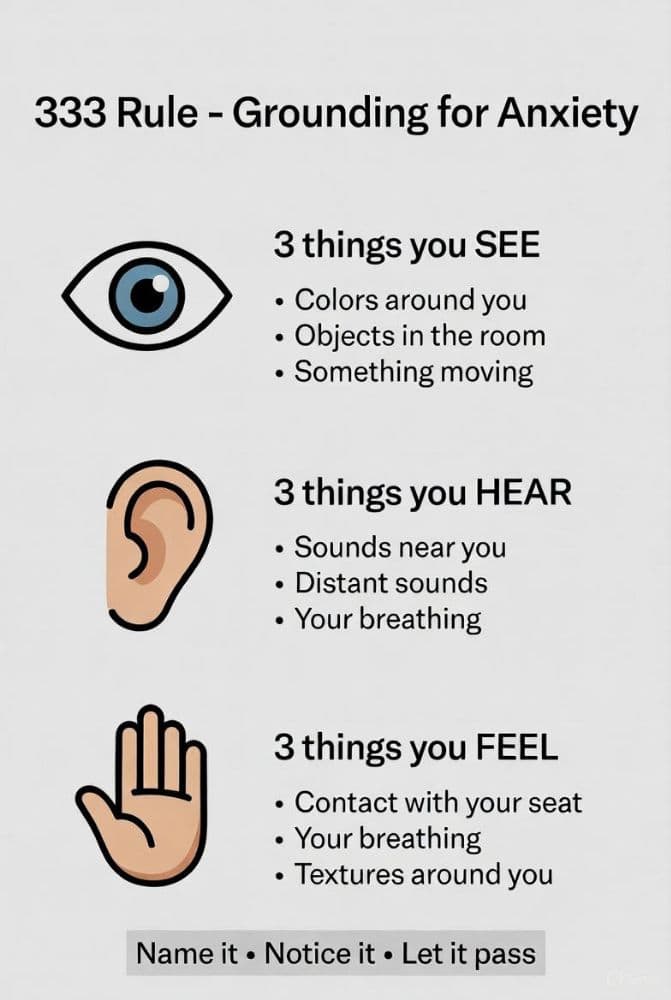
- Eye 👀 = 3 things you see
- Ear 👂 = 3 things you hear
- Hand ✋ = 3 things you feel
Anxiety is driven by the brain’s threat detection system. The 333 rule activates sensory processing and the prefrontal cortex — the thinking, logical part of the brain — which down-regulates the amygdala, the brain’s alarm center.
- Interrupts rumination: naming real things breaks repetitive thoughts.
- Engages senses: senses anchor you in the present moment.
- Calms physiology: attention shift lowers heart rate and breath.
How to Practice the 333 Rule — Step by Step
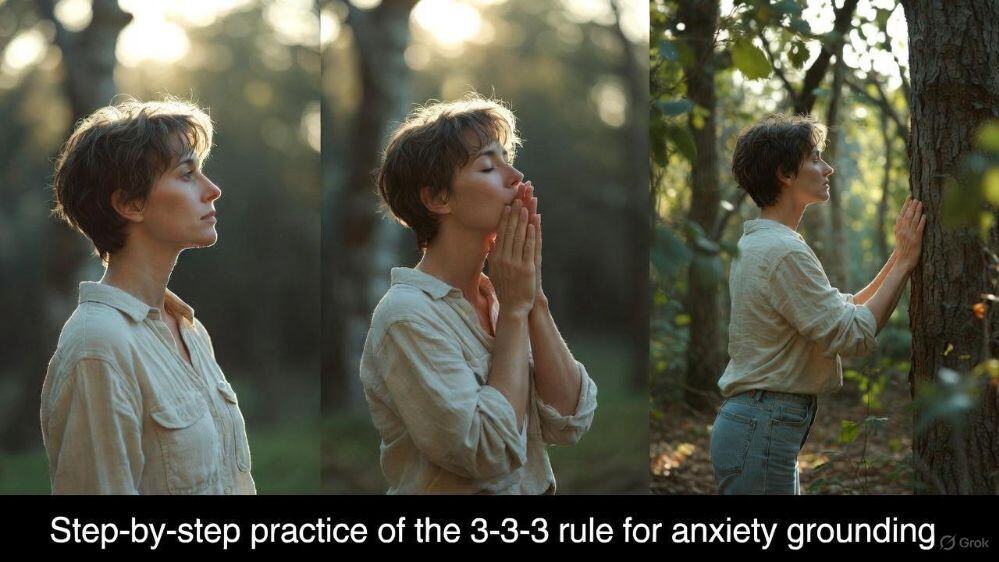
- Step 1 — See 3 Things
Look slowly around you and name three visible items. Examples: “Green plant, blue mug, window.” Say them aloud or in your head.
- Step 2 — Hear 3 Sounds
Listen and identify three different sounds. Examples: “Distant traffic,fan hum, bird singing.”
- Step 3 — Feel 3 Sensations
Notice three physical sensations: the texture of your shirt, your feet on the floor, the weight of your hands. Touch or move each if helpful.
Repeat the full cycle 1–3 times as needed. Pairing it with slow breathing (inhale 4 — exhale 6) increases the calming effect.
Read also Breathing Awareness Exercises for Anxiety Relief
Guided Practice Video
If you prefer audio guidance, the following video demonstrates a calming grounding exercise.
Video credit: Embedded from YouTube. All rights belong to the creator @StressFreeMindset.
Short Story — Mia’s 333 Moment (Child-Friendly & Gentle)

Mia’s stomach felt jumpy before her school recital. Her palms were sweaty and her thoughts kept saying, “What if I forget the words?”
She remembered the 333 rule. She looked and named: a yellow balloon, a teacher’s red scarf, sunlight on the floor. She listened: the piano, soft whispers, a bird outside. She felt: the cool stage floor under her shoes, the edge of the paper in her hand, her heartbeat slowing as she breathed.
For a moment, everything was calm. Mia stepped forward and read her part with a smile. The 333 rule hadn’t removed her nerves, but it had given her a safe place to stand inside them.
Also View Natural Remedies for Anxiety
Benefits of the 333 Rule
- Immediate reduction in anxious intensity
- Portable — works at school, work, or on the bus
- Safe for all ages, including children
- Strengthens mindfulness and self-awareness
- Easy to teach and remember
- Complements breathwork and guided meditations (see Guided Meditations for Anxiety)
When to Use the 333 Rule
Use it whenever anxiety spikes:
It is especially useful for mild to moderate anxiety symptoms. before presentations, during panic, in crowded places, before sleep, or anytime your thoughts feel out of control.daily micro-practice to build resilience.
See Related topic of How to Stop a Panic Attack Naturally
Frequently Asked Questions
Yes — many people and therapists find it effective for quick grounding.
Often within 20–60 seconds; repeat if needed.
Yes — it’s simple and child-friendly.
As often as needed — there are no risks to frequent use.
It helps reduce intensity and supports returning to calm, but combine with professional care for severe panic.
No — it’s a tool, not a replacement. Use therapy for ongoing anxiety disorders.
Yes — slow breathing (e.g., 4 in / 6 out) amplifies benefits.
Yes — daily practice builds resilience and awareness.
Final Thoughts & Call to Action
Note: This article is for educational purposes only and does not replace professional medical or mental health advice.
The 333 rule is a practical, fast, and compassionate tool to help you in moments of anxiety. It’s easy to teach children, simple to remember, and reliable in stressful situations. Pair it with breathwork and guided meditations to build lasting calm — explore our Guided Meditations for Anxiety to deepen your practice.
If this post helped you, sharing your experience and share this article with someone who might benefits.
Sources & References
The information in this article is based on widely accepted mental-health research and guidance from reputable medical and psychological organizations:
- Harvard Health Publishing –Mindfulness and Anxiety Source: Harvard Medical School Reference topic: How mindfulness and grounding techniques calm the brain and reduce anxiety symptoms.
- Cleveland Clinic –Grounding Techniques for Anxiety Source: Cleveland Clinic (USA) Reference topic: Use of sensory grounding methods to manage anxiety and panic attacks.
- WebMD –Anxiety Disorders Overview Source: WebMD Medical Reference Reference topic: Symptoms of anxiety, panic responses, and non-medication coping techniques.
- National Institute of Mental Health (NIMH) –Anxiety Disorders Source: U.S. Department of Health & Human Services Reference topic: Evidence-based approaches for managing anxiety and emotional regulation.
- Mayo Clinic –Anxiety Disorders & Self-Care Source: Mayo Clinic Reference topic: Anxiety coping strategies, relaxation techniques, and when to seek professional help.
