

Best Books for Overcoming Panic Attacks (Therapist-Recommended Picks That Actually Help)
Panic attacks can feel terrifying. Your heart races. Your chest tightens. You feel dizzy, disconnected, or like you’re about to lose control. Even though panic attacks are not dangerous, they can feel life-threatening in the moment.
The good news? Recovery is possible. And the right book can completely change how you understand and respond to panic.
In this guide, you’ll discover the best books for overcoming panic attacks, which ones use Cognitive Behavioral Therapy (CBT), and how to choose the right one for your situation.
Understanding Panic Attacks
A panic attack is a sudden surge of intense fear that peaks within minutes. Common symptoms include rapid heartbeat, shortness of breath, chest pain, dizziness, sweating, and fear of losing control.
The problem is not the symptoms — it’s the fear of the symptoms.
Most panic disorder develops when:
- You experience a panic attack.
- You become afraid of having another one.
- You start avoiding situations.
- Your nervous system becomes hypersensitive.
- Panic becomes more frequent.
The right book helps you break that cycle.
What Makes a Good Panic Attack Book?
- Uses Cognitive Behavioral Therapy (CBT)
- Includes exposure techniques
- Teaches thought restructuring
- Explains panic physiology
- Provides step-by-step exercises
Avoid books that promise instant cures or rely only on positive thinking.
1. Dare by Barry McDonagh
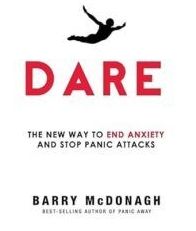
Best For: Breaking the fear of panic
This book teaches a counterintuitive approach: instead of fighting panic, you lean into it. The DARE method focuses on removing fear of sensations so panic loses power.
- Practical 4-step method
- Exposure-based approach
- Reduces fear sensitivity
2. The Panic Attacks Workbook by David Carbonell

Best For: Structured CBT recovery
This workbook offers step-by-step exercises to help retrain your response to panic.
- Breathing retraining
- Exposure exercises
- Thought-challenging worksheets
3. When Panic Attacks by David D. Burns

Best For: Catastrophic thinking
This book focuses on identifying and correcting distorted thoughts that fuel panic.
- Research-backed CBT tools
- Easy-to-understand examples
- Strong focus on thought restructuring
4. Hope and Help for Your Nerves by Claire Weekes

Best For: Chronic anxiety sufferers
This classic book introduces the “Face, Accept, Float, Let Time Pass” method to reduce fear of fear.
- Gentle tone
- Acceptance-based approach
- Effective for long-term panic
5. Mastery of Your Anxiety and Panic by David H. Barlow

Best For: Clinical-level CBT
Often used in therapy programs, this book provides structured exposure and behavioral exercises.
- Interoceptive exposure
- Behavioral experiments
- Advanced CBT structure
6. The Anxiety and Phobia Workbook by Edmund J. Bourne

Best For: Comprehensive anxiety recovery
Covers panic disorder, relaxation techniques, lifestyle adjustments, and coping skills.
7. Rewire Your Anxious Brain by Catherine Pittman

Best For: Understanding panic from a brain perspective
Explains how the amygdala triggers panic and how to retrain fear circuits.
Comparison Table
| Book | Best For | Therapy Type | Difficulty |
|---|---|---|---|
| Dare | Fear of panic | Exposure-based | Easy |
| The Panic Attacks Workbook | Structured recovery | CBT | Moderate |
| When Panic Attacks | Catastrophic thinking | CBT | Moderate |
| Hope and Help for Your Nerves | Chronic anxiety | Acceptance | Easy |
| Mastery of Your Anxiety | Severe panic | CBT | Advanced |
How to Choose the Right Book
Choose exposure-based books if:
- You avoid places due to panic
- You fear physical sensations
- You constantly scan your body
Choose CBT-focused books if:
- You struggle with catastrophic thinking
- You overanalyze symptoms
- You Google health fears frequently
Choose acceptance-based books if:
- You feel stuck in chronic anxiety
- You are exhausted from fighting panic
Final Thoughts
Panic attacks feel overwhelming, but they are one of the most treatable anxiety conditions. The right book can change how you interpret symptoms, reduce fear sensitivity, and break avoidance patterns.
Recovery is not about eliminating anxiety completely. It’s about removing the fear of anxiety. Once fear fades, panic fades.
